
Meet Renvio’s New CEO: Listening First, Leading with Focus
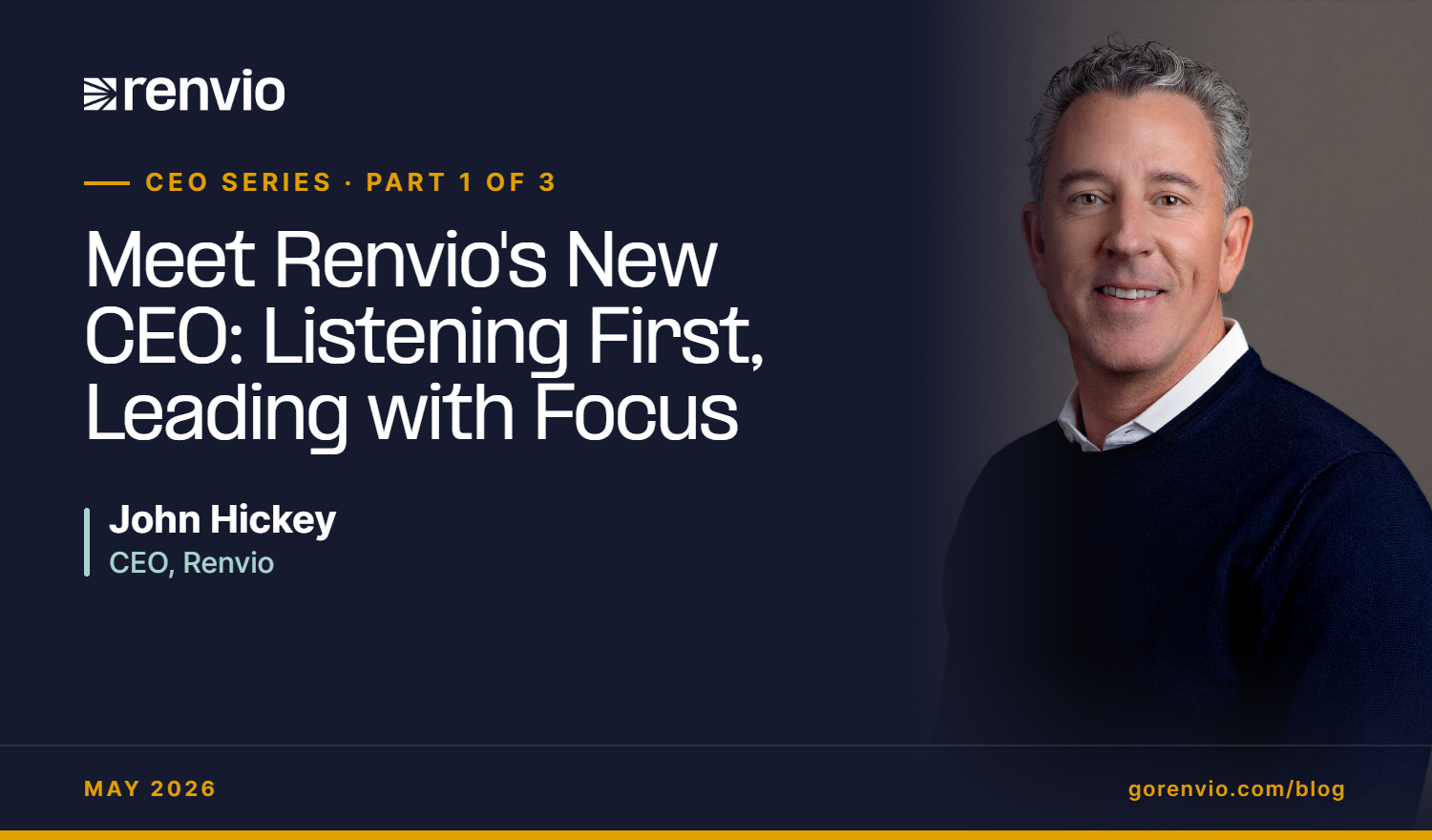
“I do not believe in change for the sake of change. I believe in understanding first, then acting with focus.” - John Hickey, CEO of Renvio
As of May 1, 2026, John joins Renvio with more than 20 years of experience building and scaling technology businesses across healthcare, financial services, and automotive software. But as he begins his first 30 days as CEO, his focus is not on arriving with immediate answers. It is on learning from the people who know the work best.
That means spending time with Renvio’s team, customers, partners, and the broader renal care community to understand what has already been built, where the company is strongest, and where he can help remove obstacles.
In this three-part Q&A series, John shares what drew him to Renvio, what he is learning so far, and how he is thinking about leadership, focus, renal care, and the opportunity ahead.
1. What drew you to Renvio?
What drew me to Renvio is the directness of the connection between what this company does and the people it serves. When I look at where I want to spend the next chapter of my career, I want it to be a place where the work matters to real people. Renvio sits in that space. Patients with kidney disease are in care relationships that often last years. The clinicians who serve them carry real responsibility. The organizations behind them have a complicated job to do. Technology that serves any of that well has earned its place.
I have spent more than 20 years building technology businesses, including in healthcare, financial services, and automotive software. The companies that have stuck with me are the ones with focus. Not the ones trying to be everything to everyone, but the ones that picked a market, learned it deeply, and committed to serving it well. Renvio has spent years building around renal care, and that kind of focus is rare and valuable.
I am four days in as I write this, and what stood out in my first conversations with the leadership team was the depth of knowledge in the room. People here know their customers by name. They know the workflows, the pain points, and the history. That is the kind of foundation you cannot manufacture. You can only build it over time, and Renvio has.
2. What did you notice first about the people and the work at Renvio?
The first thing I noticed was the level of care people bring to the work. There is a real sense of ownership here, and a deep respect for the clinics and clinicians Renvio supports. In my first week alone, I have sat with leaders across product, engineering, sales, marketing, and client services, and the consistent thread is that people are paying attention to the right things.
A few examples without going into the weeds. The team has been doing the unglamorous work of unifying its platform so every customer experiences the same product on the same release cadence. That is not a flashy initiative. It is the kind of thing a team takes on when they care about getting the customer experience right at scale. I have also seen the trajectory on customer satisfaction over the past two years, and it is moving in the right direction. That does not happen unless people across the company are deciding, every day, to do the harder thing.
One of the things I have learned over the years is that strong companies are rarely built by accident. When you find a team with deep customer knowledge, low turnover, and a culture people describe as collaborative and low on internal politics, that tells you something. It tells you there is a foundation worth respecting.
My job is not to come in and assume I have all the answers. My job is to understand what has made the company strong, where the team needs support, and how I can help remove obstacles.
3. You have said the first 30 days are about listening. What does that mean in practice?
It means exactly that. Listening before acting.
In practical terms, I have framed my first 90 days in three phases. The first 30 days are about listening and learning. No big decisions, no new strategies, no announcements. The next 30 days are about taking what I have learned and building a plan with our board, our leadership team, and the people closest to our customers. The 30 days after that are about acting on it with focus.
I do not believe in change for the sake of change. I believe in understanding first, then acting with focus. The people closest to the work always know things a leader needs to hear. That includes our employees, our customers, our partners, and the broader renal care community.
In the first 30 days, I want to learn how the business actually works, how customers experience us, where the team sees opportunity, and where I can be most useful. Next week I will be in Seattle for time with customers and the team, and that kind of in-person time matters. You can read every report and listen to every recap, but you learn different things when you are in the room.
4. How does your past experience shape how you will lead Renvio?
I have spent more than 20 years building and growing technology businesses across healthcare, financial services, and automotive software. Those experiences taught me that every market is different, but strong execution depends on a few consistent things. Clarity about where you are going. Focus on what matters most. Accountability for the work. And trust between the people doing it.
I have also learned that leaders should not confuse activity with progress. Busy teams are not always moving toward the right outcomes. Part of my job is to help create clarity around where we are headed, what matters most, and what obstacles need to be removed so the team can do its best work.
A few areas I expect to be paying close attention to over time. Operating discipline and the rhythm of how we run the business. The product and how it continues to serve customers as their needs evolve. Our go-to-market engine and how we tell our story. Our people and how we set them up to succeed. And our customer experience from the day a contract is signed through the years of partnership that follow. Those are not new ideas. They are the basics of building a durable business. Doing them well, in the right order, is what separates good companies from great ones.
But before I act on any of that, I need to understand the company, the customers, and the market as they exist today. That is why listening comes first.
5. What do you want employees to know as you step into the role?
I want employees to know that I respect what has been built here.
This company has a strong foundation, and that does not happen by accident. I am not here to change things simply because I am new. I am here to understand what is working, where we can improve, and how I can help the team do its best work.
I also want people to know what I value and what I am asking for. I value directness. If something is working, I want to understand why. If something is getting in the way, I want to know that too, the earlier the better. Good teams need clarity, resources, and a leader who removes obstacles. That is the job I am here to do.
A few practical things. I have been spending my first weeks in 1:1s with leaders across the company, and I am setting up regular cadences with each of them so the conversation continues. I expect to be on the road a lot, and I want as much of that time as possible spent with our customers and with our team in the places where the work happens. If you have something you want me to see or hear, I want to know about it.
6. What do you want the team to feel in your first few months?
Honestly, I want people to feel steady. Leadership transitions are unsettling even when they go well, and I know there are natural questions when a new CEO walks in the door. My hope is that the first few months feel less like upheaval and more like continuity with a new set of eyes.
I want people to feel heard. If you have spent the first weeks telling me about your part of the business, I want you to see that I actually listened, that what you said is shaping how I think, and that the things you flagged are not disappearing into a black hole.
I also want people to feel a little more clarity over time. Not because we are about to announce a sweeping new strategy, but because good listening should produce sharper questions, better priorities, and a clearer sense of where we are headed together. That is the work of the first 90 days.
7. How do you build trust?
My way of building trust is simple. People should be able to count on me to do what I said I would do, to tell them the truth even when it is hard, and to put the company and the team ahead of myself. If I am consistent on those three things, trust follows. If I am not, no amount of communication will fix it.
In practice, that shows up in small moments more than big speeches. You build trust by doing what you said you would do. By being direct when something is not working. By giving people credit when things go well. By being the same person in a board meeting that you are in a hallway conversation.
For me, it also comes down to a few habits. I try to listen more than I talk, especially early. I try to ask questions before I offer opinions. I try to be honest when I do not know something, because pretending you do is the fastest way to lose a team’s confidence. And I try to be available. The people closest to the work should not have to wait three weeks to talk to me about something that matters.
The other piece is consistency. Trust is not something you earn once and then bank. It is something you re-earn every quarter. I take that seriously.
8. What kind of feedback do you want from employees?
The kind that is uncomfortable to give. That is the feedback that is most useful.
I want to hear what is working, but I am especially interested in what is getting in the way. Where are we slow when we should be fast? Where are we making things harder than they need to be? Where do you see something that the leadership team is missing? Where are you having to work around the system instead of with it?
I also want to hear about me. If something I am doing is not landing, or if I am asking the wrong questions, or if I am missing context I should have, tell me. I would rather hear it directly and early than learn about it six months later when it is harder to fix.
The deal I want to make with employees is simple. Be honest with me, and I will be honest with you. Tell me the hard things, and I will do the work to act on them or explain why I cannot. That is the kind of relationship that makes a company better over time.